
Find Minnesota Public Records
Minnesota public records are open to anyone by default. The state's Government Data Practices Act makes most government data public unless a specific law says otherwise. You can search court cases, criminal history, property filings, vital records, inmate data, and business registrations through official state and county systems. This guide covers the main places to find public records in Minnesota, how each system works, and what to expect. Whether you start online or visit a county office in person, the right agency depends on what type of record you need.
Minnesota Public Records Overview
Minnesota Public Records Law
The Minnesota Government Data Practices Act is the core law that shapes how the state handles public records. Under Minn. Stat. Chapter 13, all government data is presumed to be public unless a specific statute classifies it as private, confidential, or nonpublic. This puts the burden on agencies to justify keeping data private. The law covers state agencies, counties, cities, school districts, and all other government bodies. Any person can inspect public data at no charge during normal business hours under Minn. Stat. § 13.03, subd. 3. If you want copies, agencies can charge a fee tied to the actual cost of reproduction.
The Information Policy Analysis Division (IPAD) at the Minnesota Department of Administration advises agencies and citizens on data practices questions. Their number is (651) 296-6733. IPAD handles formal disputes over data access and has issued advisory opinions on many types of records. If an agency denies your request without proper justification, you can file a complaint with IPAD or seek relief in district court under Minn. Stat. § 13.08. The process is not complicated, but it helps to cite the statute when making your initial request.
Two other statutes work alongside Chapter 13. The Official Records Act (Minn. Stat. § 15.17) requires all government officers and agencies to create and keep accurate records of their official activities. The Records Management Act (Minn. Stat. §§ 138.163-.25) governs how long agencies must hold records before they can be destroyed or sent to the state archives. Together, these three laws form the foundation of Minnesota's public records framework.
The revisor publishes the full text of Chapter 13 online. The screenshot below shows the statute page, which is a useful starting point for anyone researching their data access rights in Minnesota.
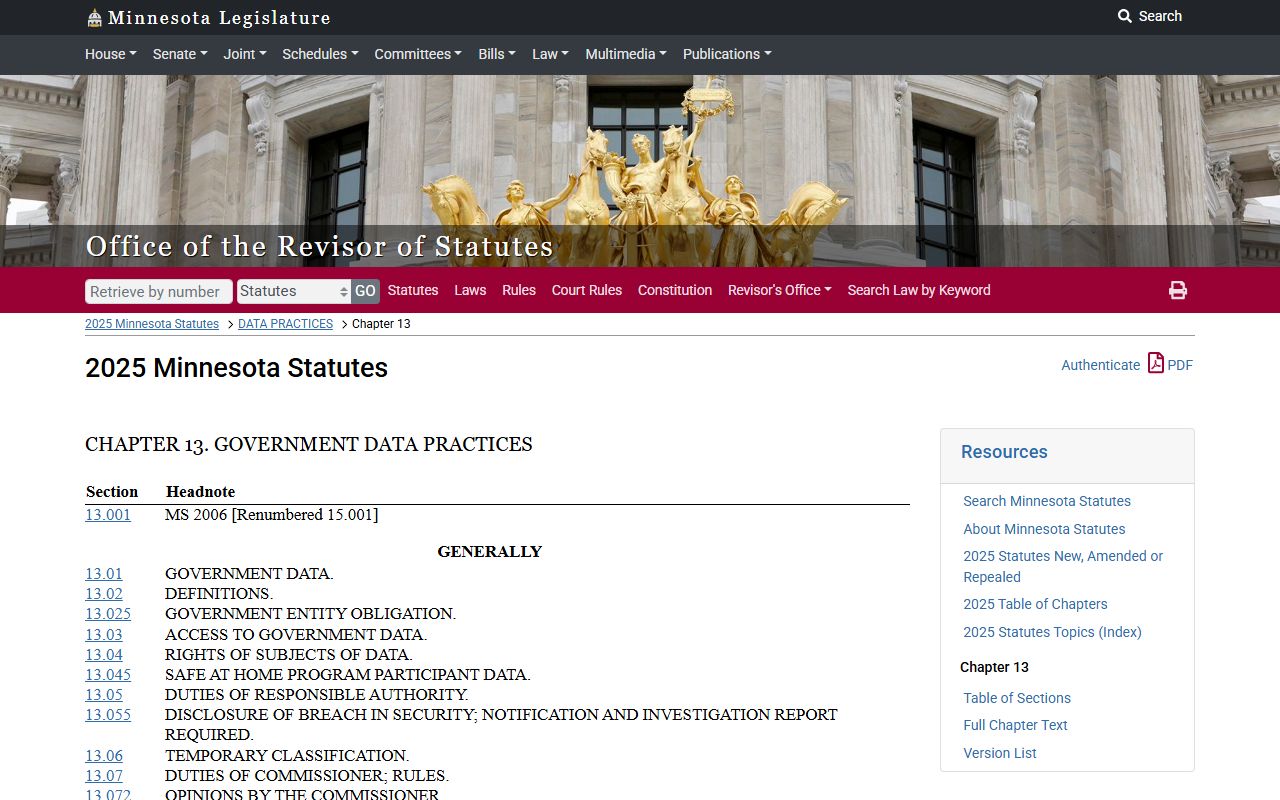
Minnesota Statutes Chapter 13 is the foundation for all public records access in the state. It defines what data is public, what is restricted, and what steps agencies must take when responding to a data request.
Court Records in Minnesota
Minnesota Court Records Online (MCRO) is the state's main public portal for district court case data. The system is free and open to anyone. You can search by person name, business name, attorney name, case number, or citation number. It covers civil, criminal, family, probate, and other case types filed across all 87 counties. Case documents filed on or after July 1, 2015 are generally available for download at no cost. Records filed before that date have limited online access, and you may need to contact the courthouse directly. Go to publicaccess.courts.state.mn.us to run a search.
The MCRO portal below is the main starting point for finding court cases anywhere in Minnesota.
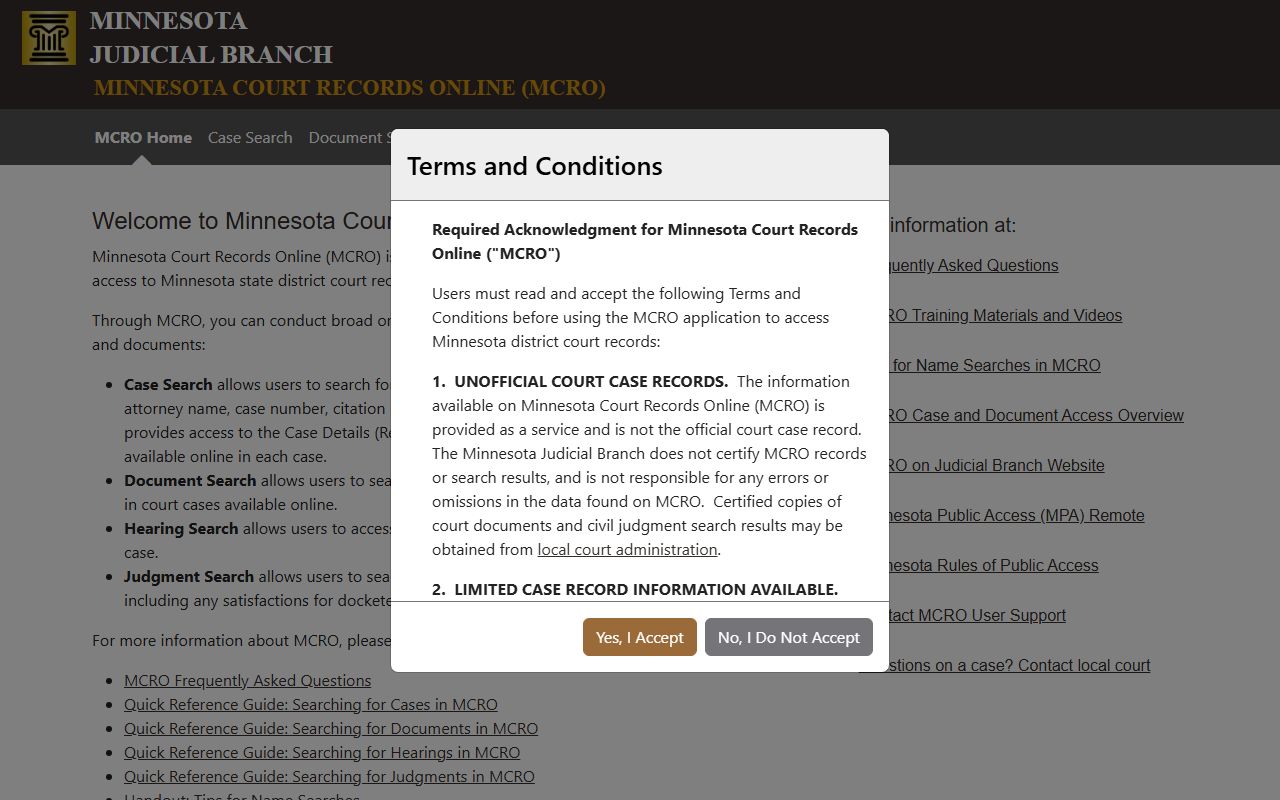
The court records system covers all 87 county district courts. You can look up party names, case status, hearing dates, and docket entries for free. For certified copies or documents not available online, contact the Court Administrator in the county where the case was filed.
Each county has a Court Administrator who manages the physical case files. Certified copies of court documents cost $14 each statewide. The State Court Administrator's office is at the Minnesota Judicial Center, 25 Rev. Dr. Martin Luther King Jr. Blvd., St. Paul, MN 55155, phone (651) 297-7650. Minnesota has 10 judicial districts, and each district covers a group of counties. Court records are governed by the Minnesota Rules of Public Access, which set out what is open and what may be restricted in civil and criminal cases.
Note: Some family court records and sealed cases have restricted access in MCRO. If you cannot find what you need online, contact the Court Administrator in the county where the case was filed.
Minnesota Criminal History Records
The Bureau of Criminal Apprehension (BCA) runs the state's public criminal history database. The Minnesota Public Criminal History Search costs $8 per name. You need the subject's full name and date of birth to run a search. Results include conviction data going back 15 years from the completion of any sentence, arrest records that are public under Minn. Stat. § 13.82, and sex offender registration status. Federal crimes, active investigations, and records from other states are not included. The BCA's office is at 1430 Maryland Avenue East, St. Paul, MN 55106, phone (651) 793-7000.
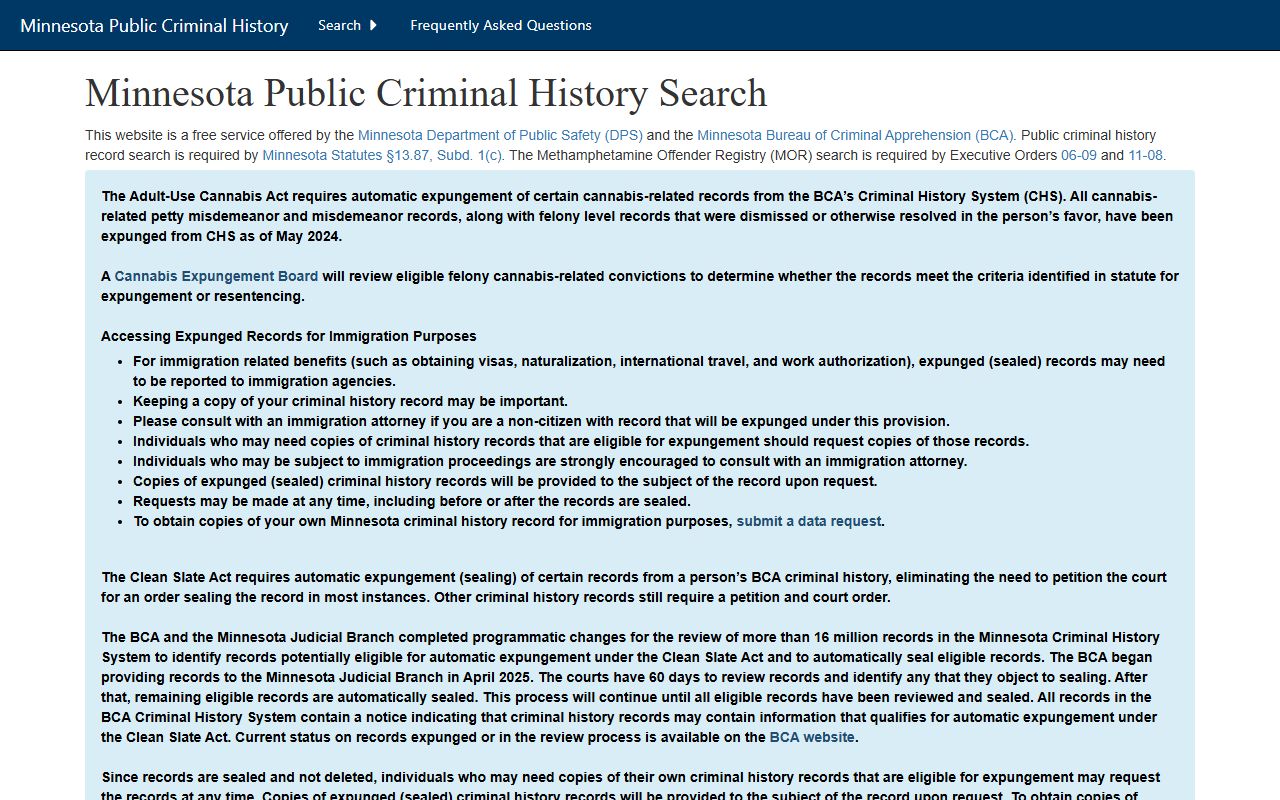
The BCA criminal history portal at chs.state.mn.us returns results in real time. Searches cost $8 and show conviction records, public arrest data, and sex offender status when applicable.
Criminal history data is governed by Minn. Stat. § 13.87, which defines what the BCA can make public and under what terms. Juvenile records are generally sealed under Minn. Stat. § 260B.171 and are not part of the public search. Expunged records are removed from public view once a court order is entered. Conviction data stays in the public database for 15 years following the end of a sentence, unless expunged or otherwise restricted by a court.
Vital Records in Minnesota
The Minnesota Department of Health (MDH) keeps the state's vital records index. The records include birth certificates going back to 1900, death certificates, and a statewide index of marriages and divorces. Birth certificates are not public for 100 years under state law. Death certificates become public after 50 years. Marriage and divorce documents are court records and must be requested from the county where they were filed or from the relevant district court. MDH can issue a verification letter for a marriage or divorce, but the full document comes from the courthouse. Standard processing runs 4 to 6 weeks, though many county offices offer faster in-person service. A birth certificate costs $26 and a death certificate costs $13. Visit the MDH vital records page to start a request or learn more about what is available.
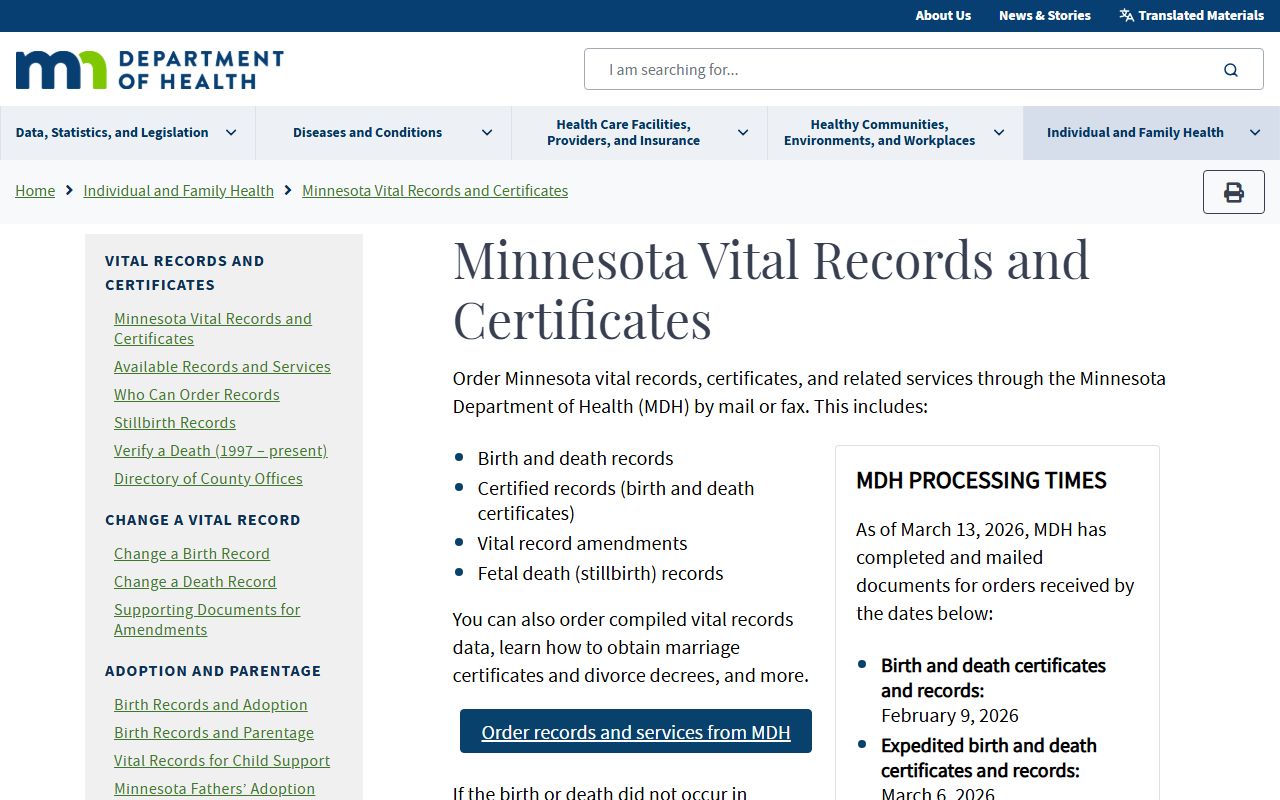
The MDH vital records portal handles birth and death certificate requests for all of Minnesota. Marriage license copies go through county offices, and divorce decrees come from the district court in the county where the case was filed.
Minnesota Property Records
Property records in Minnesota are maintained at the county level. Every county has a Recorder's office and an Assessor's office. The Recorder files deeds, mortgages, liens, and other land documents under Minn. Stat. Chapter 507. The standard recording fee statewide is $46 for the first page and $10 for each additional page. The Assessor tracks parcel values, ownership, and tax assessment data. Most counties have an online property search tool. You can usually look up parcels by address, owner name, property ID number, or interactive map. Property records are public and kept permanently. Tax records are generally maintained for seven or more years.
The Office of the State Auditor reviews local government finances and publishes reports on county and city revenue. Their audit data includes property tax information across all 87 counties and is available to the public at no charge.
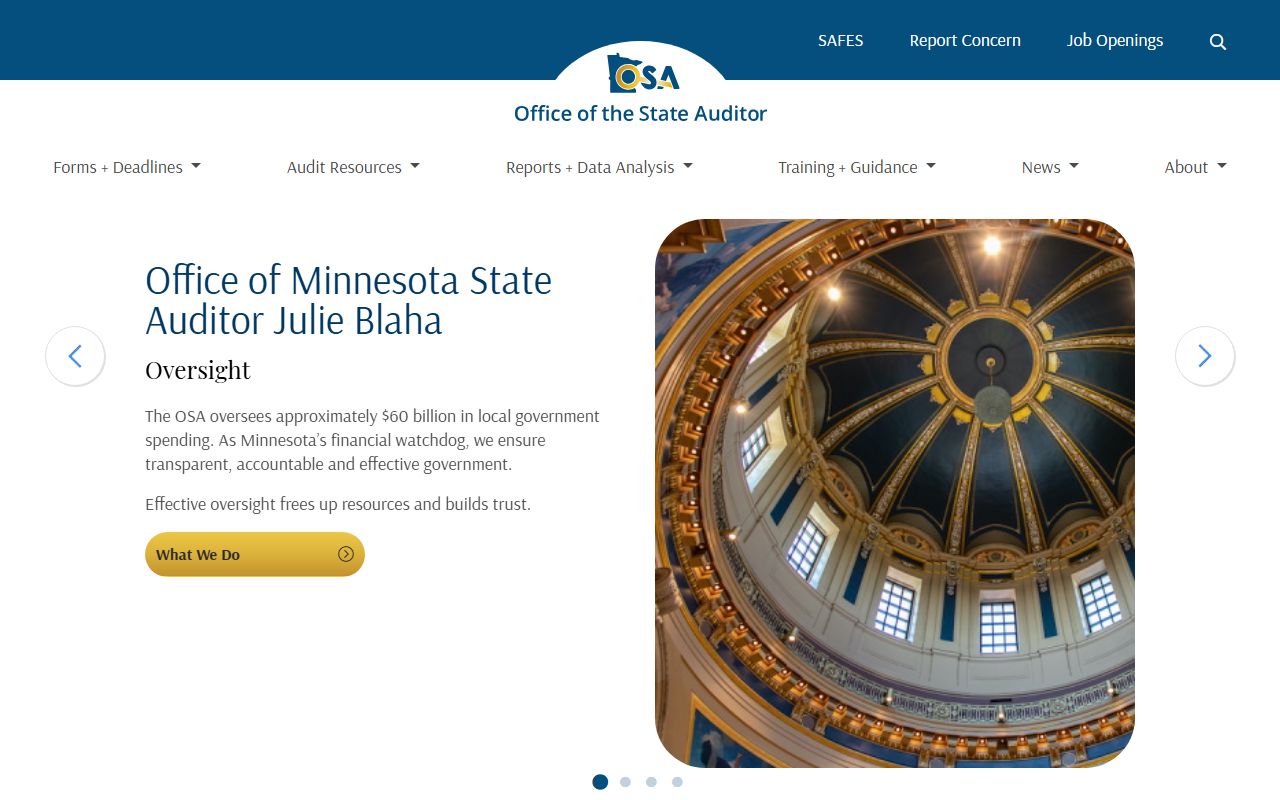
The Office of the State Auditor publishes financial reports covering all Minnesota counties and cities, including property tax data and fund balances. These reports are available online at osa.state.mn.us.
Inmate and Offender Searches
The Minnesota Department of Corrections operates two public search tools for offender data. The Inmate Locator at coms.doc.state.mn.us/publicviewer lets you search for anyone currently committed to the Commissioner of Corrections, including people on supervised release. The tool shows current custody status, facility location, and projected release dates. If you are looking for a DOC fugitive, there is a 24-hour tip line at 651-603-0026. Written records requests can go to CO-Records.DOC@state.mn.us or call (651) 361-7330.
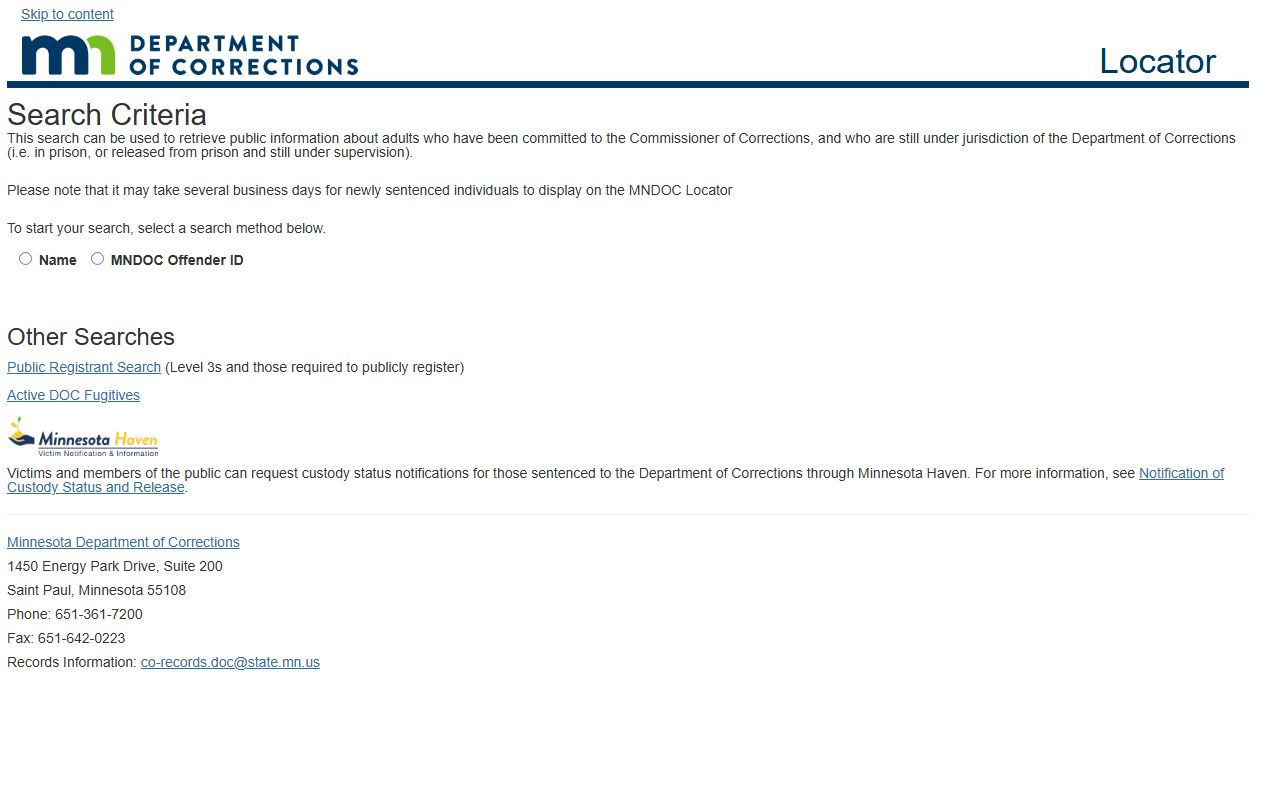
The DOC inmate locator is updated in real time and covers people in state correctional facilities as well as those on supervised release or other community supervision across Minnesota.
The second tool is the Predatory Offender Registry. Under Minn. Stat. § 243.166, registered offenders must keep their information current for at least 10 years, and in some cases for life. Level 3 offenders carry the highest public risk rating and are fully listed in the public search at coms.doc.state.mn.us/publicregistrantsearch. You can search by city, county, name, or zip code. Level 1 and Level 2 offenders are registered with law enforcement but have more limited public visibility. Community notification rules are governed by Minn. Stat. § 244.052.
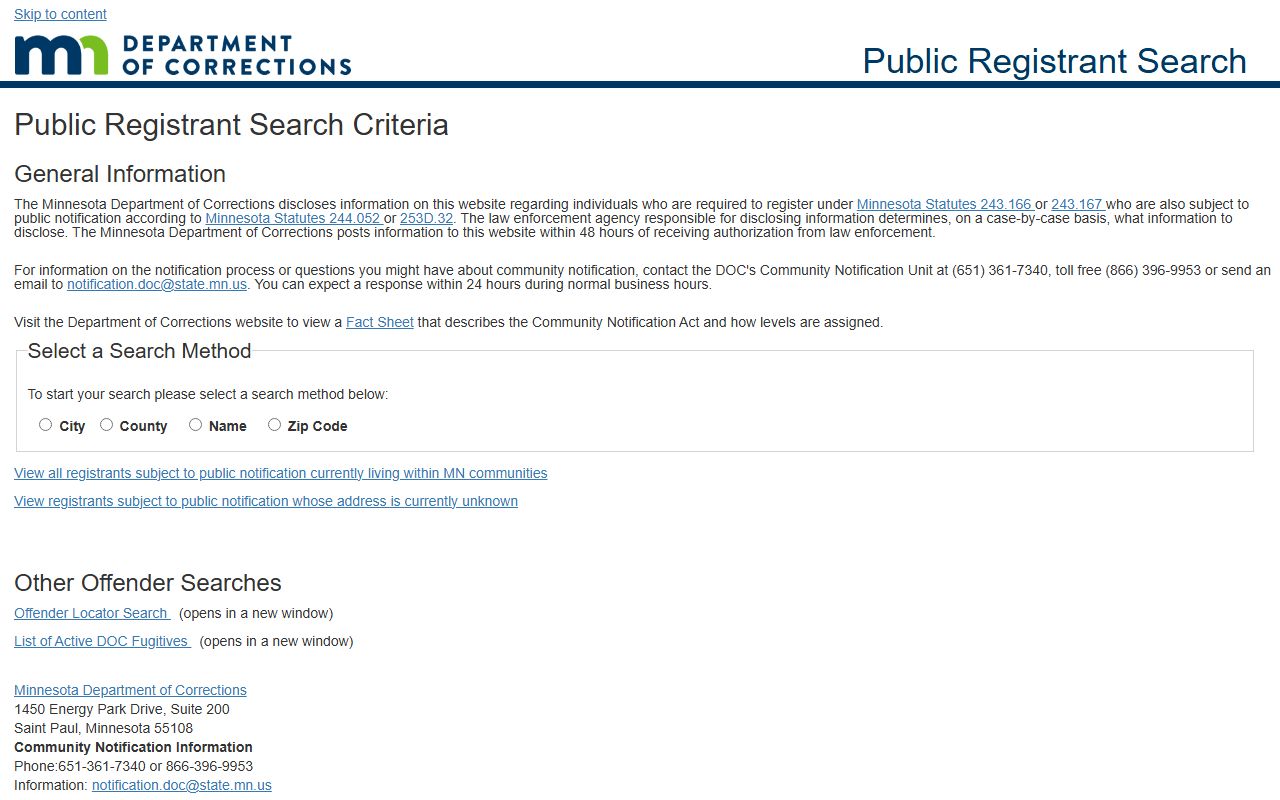
The predatory offender search tool shows Level 3 registrants searchable by location. The database is maintained by the DOC and updated as new registrations are filed or existing registrations change.
Minnesota Business Records
The Minnesota Secretary of State keeps filings for all business entities registered in the state. You can search corporations, limited liability companies, assumed names, and nonprofits at no cost. The system at sos.mn.gov/business-liens lets you filter by active or inactive status and shows full filing histories, amendments, and renewals. The office also handles Uniform Commercial Code (UCC) filings, notary records, and farm product liens through the Central Notification System. Walk-in service is available at 332 Minnesota Street, Suite N201, Saint Paul, MN 55101. For questions, email business.services@state.mn.us.
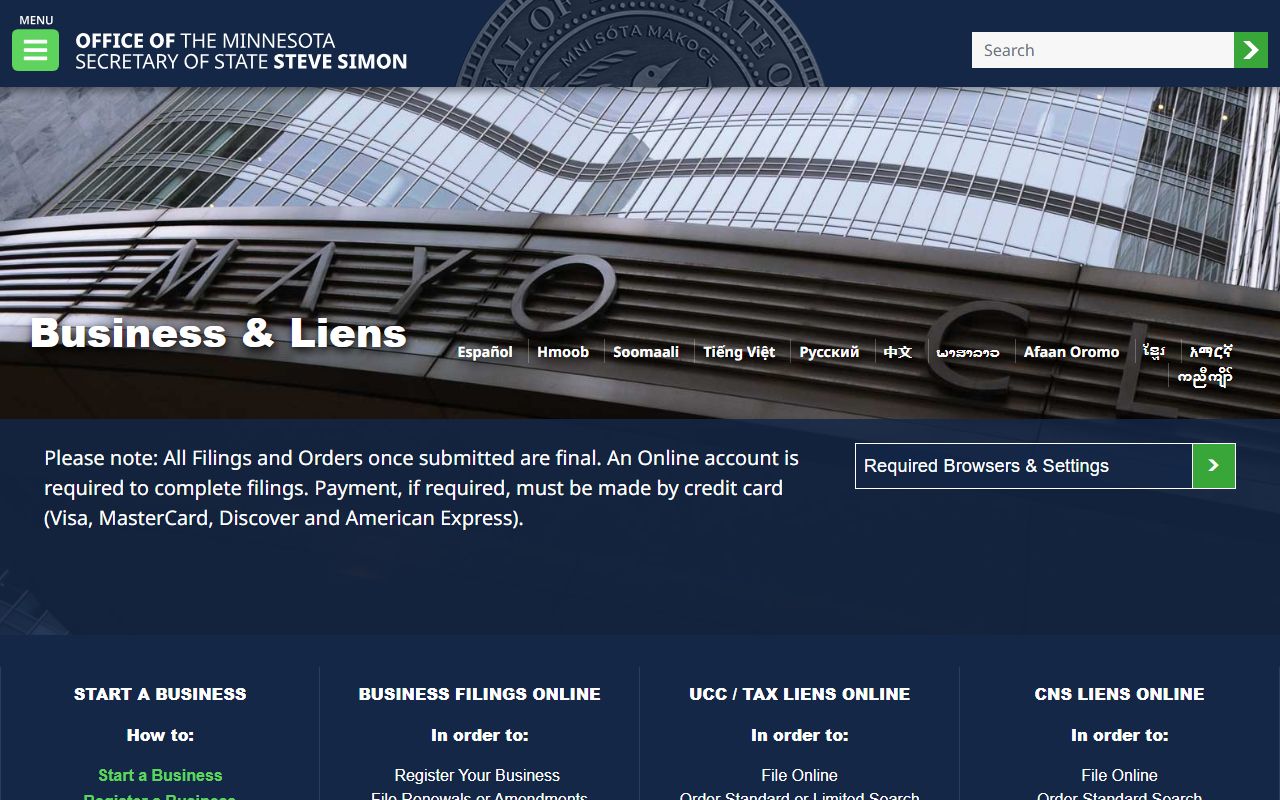
The Secretary of State business search covers all entities registered in Minnesota. Search results include the registered agent, current status, and a complete filing history going back to the date of formation.
State Agencies and Public Data
The Minnesota Department of Public Safety (DPS) handles driver records, vehicle registration data, crash reports, and crime statistics. Driver and Vehicle Services can be reached at (651) 296-2940. The DPS Office of Traffic Safety publishes annual crash facts reports with statewide vehicle incident data. The DPS also manages law enforcement support and houses the BCA. Visit dps.mn.gov for a full list of DPS divisions and their public data contacts. DPS is an important hub for a range of Minnesota public records that go beyond court filings.
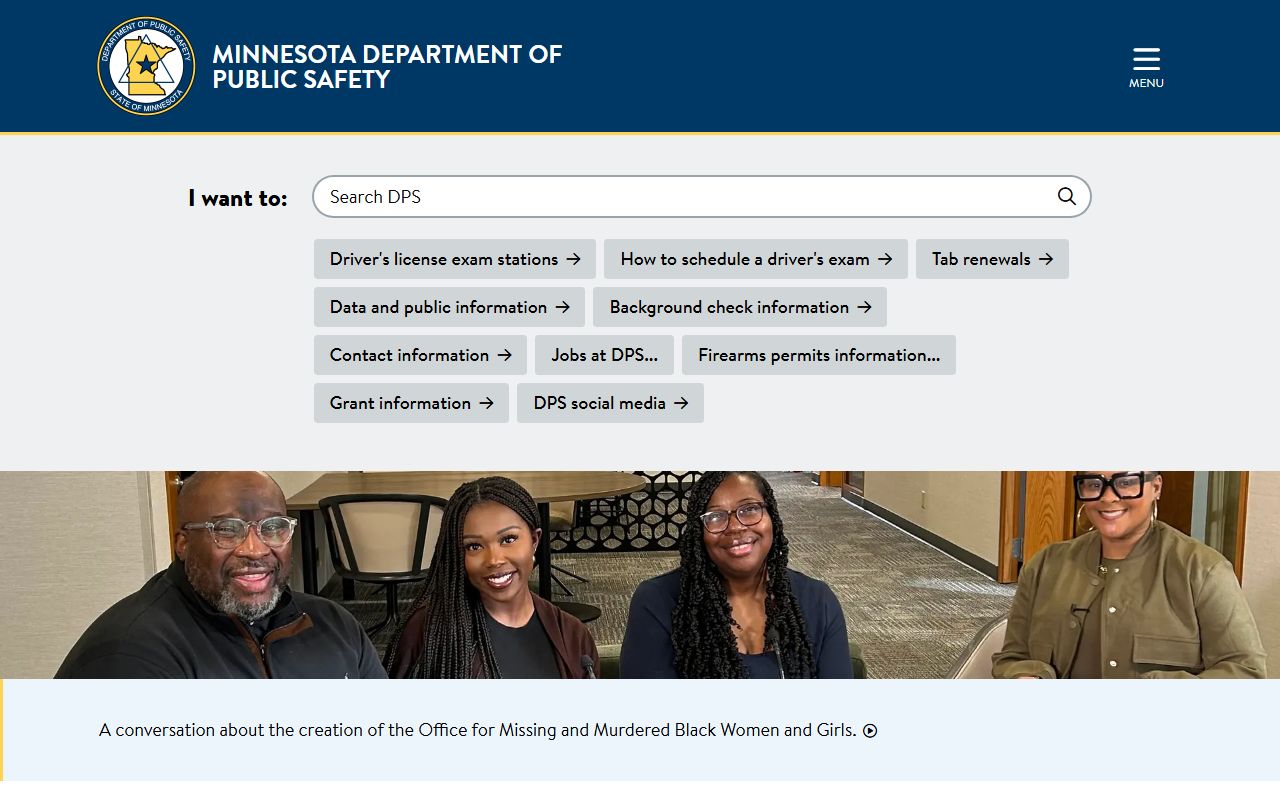
The Minnesota DPS website serves as the central entry point for public safety data, including driver records, crash statistics, and criminal justice data maintained by the Bureau of Criminal Apprehension.
The Legislative Reference Library is a research resource for statutory history and legislative records. It covers bill tracking, committee records, and archived session laws. Visit lrl.mn.gov to access the library's public records tools. This is the right place to trace how a Minnesota statute changed over time or to research the legislative history behind a law.
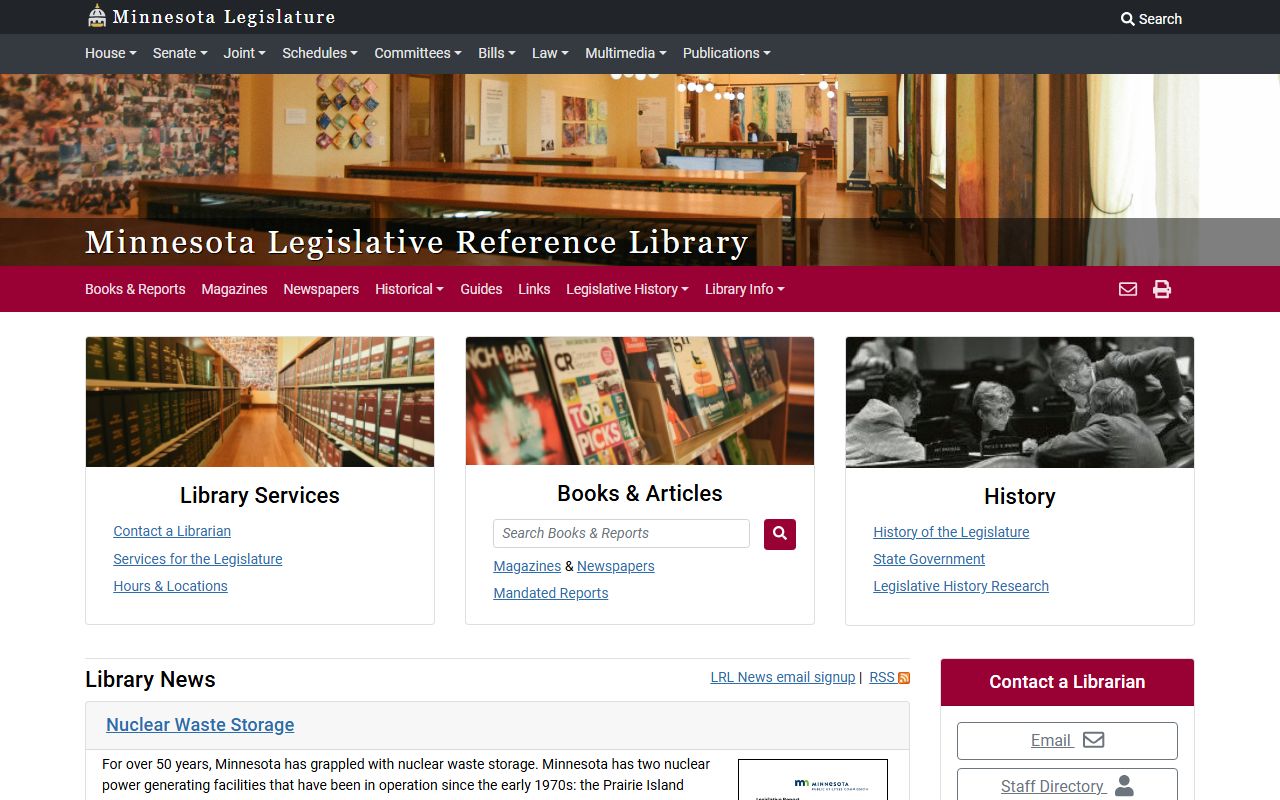
The Legislative Reference Library maintains archives of Minnesota statutes and session laws. Its online tools are free and open to the public without any need to create an account.
How to Request Minnesota Public Records
Requesting public records in Minnesota starts with knowing which agency holds the data you need. For court records, contact the Court Administrator in the relevant county. For criminal history, use the BCA portal online or send a written request to the BCA office. For property records, reach out to the county Recorder or Assessor. For state agency data, identify the correct department and submit a written request under the MGDPA. You do not need to give a reason. The agency must respond without unreasonable delay. There is no fixed statutory deadline, but slow responses can be challenged through IPAD or in district court.
When making a large or detailed request, being specific helps. Include names, dates, case numbers, or parcel IDs when you have them. Agencies can charge for search and retrieval time on requests that require extra work. For help understanding your rights, contact IPAD at (651) 296-6733. For historical records, the Minnesota Historical Society at 345 Kellogg Blvd W, St. Paul, phone (651) 259-3260, holds older government archives including historical court records and county files.
Note: You do not need to be a Minnesota resident to request public records. The MGDPA gives access rights to anyone, regardless of where they live or why they are asking.
Browse Minnesota Public Records by County
All 87 Minnesota counties maintain their own court, property, vital, and law enforcement records. Click a county below to find local contact info, office addresses, and resources for that area.
View All 87 Minnesota Counties
Minnesota Public Records by City
Residents of Minnesota's largest cities access records through their county's courts and government offices. Select a city to find contact details, courthouse info, and local resources for public records.